Paper: "The psychological significance of lifelong visual imagery vividness extremes"
This one on the differences between aphantasics, hyperphantasics & controls
While waiting for the second part of the other paper, here’s part of an entirely different paper!
Phantasia–The psychological significance of lifelong visual imagery vividness extremes (Zeman, Adam, et al. 2020)
Abstract snippet:
Questionnaire data from 2000 participants with aphantasia and 200 with hyperphantasia indicate that aphantasia is associated with scientific and mathematical occupations, whereas hyperphantasia is associated with ‘creative’ professions.
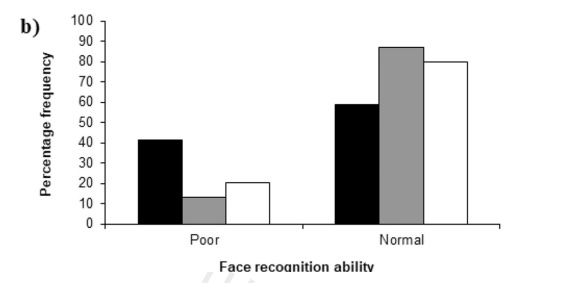
Participants with aphantasia report an elevated rate of difficulty with face recognition and autobiographical memory, whereas participants with hyperphantasia report an elevated rate of synaesthesia.
Around half those with aphantasia describe an absence of wakeful imagery in all sense modalities, while a majority dream visually.
Aphantasia appears to run within families more often than would be expected by chance. Aphantasia and hyperphantasia appear to be widespread but neglected features of human experience with informative psychological associations.
Introduction:
Studies on both healthy and clinical populations have linked the vididness, richness and fluency of autobiographical memory to imagery vividness... The neural mechanisms for these effects include both activation within and connectivity to visual cortices...
There is evidence for a relationship, also, between imagery strength, as assessed using the binocular rivalry paradigm, and the capacity of visual working memory...
..Gruter et al... reported that the mean [imagery vividness] score among individuals with congenital prosopagnosia (difficulty with familiar face recognition) was between two and three standard deviations below the normal participant mean.
In contrast, Barnett and Newell.. found elevated vividness scores among individuals with synaesthesia (‘merging of the senses’).
Vivid ‘object imagery’ has been associated specifically with an enhanced ability to identify degraded figures.. and filtered visual stimuli at low spatial frequencies.. and to distinguish degrees of ‘grain’...
Variations in imagery vividness are also associated with the risk of several psychiatric disorders: average imagery vividness is raised in patients with schizophrenia and their first degree relatives..,
while higher levels predispose to more frequent flashbacks in an experimental model of Post-Traumatic Stress Disorder..,
and to hallucinations in Parkinson's Disease...
___
Since then, studies by other investigators have identified several potential objective correlates of aphantasia:
loss of the usual priming effect of imagery in binocular rivalry.., suggesting that the underlying cause of aphantasia is sensory rather than metacognitive;
absence of the usual autonomic response to stories that would normally be expected to excite emotive imagery..;
reduction in the precision of visual working memory, reported in a single case...
..A personal account of aphantasia.. has highlighted a possible association with the recently described syndrome of Severely Deficient Autobiographical memory...
Results:
Demographics:
even sex representation among aphantasics
but there were more female hyperphantasics
There was a lower educational attainment among the controls (those who had average imagery scores), but the control group was significantly older than the other two groups, the paper doesn’t mention if that may have affected the educational attainment averages.
Results:
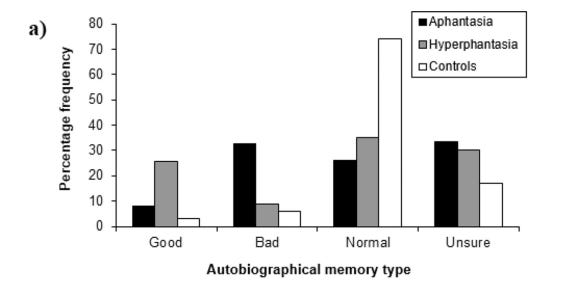
Memory:
hyperphantasics were more likely to report having good autobiographical memory than aphantasics or controls.
aphantasics were more likely to report having bad autobiographical memory than hyperphantasics or controls.
Face recognition
aphantasics had significantly higher levels of difficulty with facial recognition
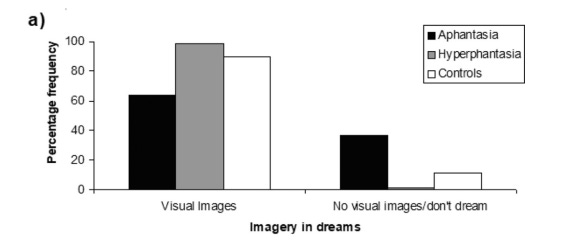
Visual imagery in dreams
20.7% of aphantasics reported dreaming without images (controls: 6.5%, hyperphantasics: .5%)
7.5% of aphantasics reported not dreaming at all (controls: .5%, hyperphantasics: 0%)
Those who had non-visual dreams “described narrative, textual, conceptual, auditory and emotional dream content.”
Influence of mood
aphantasics’s imagery was significantly less likely to be influenced by mood
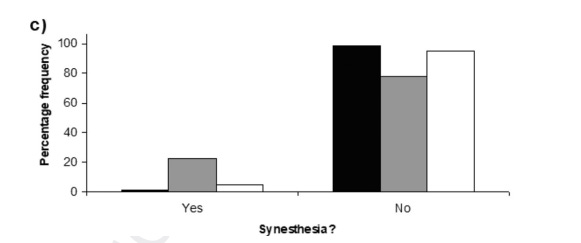
Synaesthesia
hyperphantasics more likely to report synesthesia, especially the females.
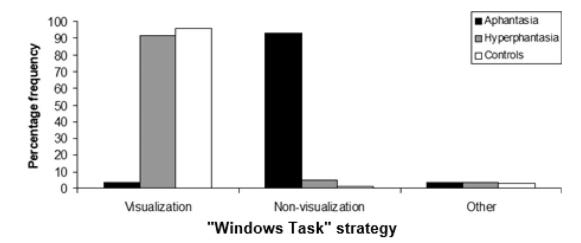
The ‘windows task’
The task was for participants to count the number of windows in their home
aphantasics were significantly less likely to use visual imagery for this, and were “significantly more likely to use alternative, non-imagery, strategies including the use of avisual spatial imagery, kinaesthetic imagery and amodal ‘knowledge’”
Effect of eye opening
aphantasis were significantly less likely to report a difference in imagery vividness when eyes were open or closed
Occupation
They only looked at the aphantasics and hyperphantasics for this, they left out the controls because their overall rate of education was lower and would have skewed the data
they expluded the unemployed/no answer results from the analysis, which I am not happy with (though a “purposefully unemployed” vs “unemployed against will” differentiation would be best), as I am an unwillingly unemployed person myself.
‘Computer and Mathematical’/‘Life, Physical and Social Sciences’ were aphantasic-heavy,
however, it was also the #2 highest occupational category for hyperphantasics
‘Arts, Design, Entertainment, Sports, and Media Occupations’ were hyperphantasic-heavy
This category was #4 highest (..out of 6…) for aphantasics, though.
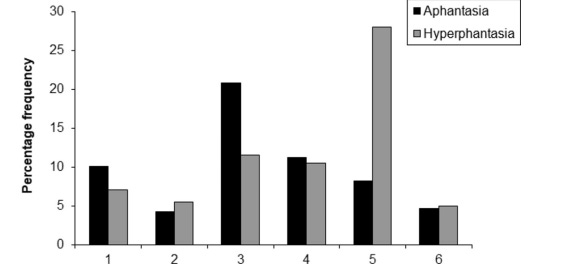
Management
Business & Financial
Computer and mathematical / Life, physical, social science
Education, training, and library
Arts, design, entertainment, sports, & media
Healthcare, practitioners and technical
(Only the categories where at least one or the other group had 5%+ frequency are shown)
Other modalities of imagery
54.2% of aphantasics were ‘aphantasic’ of all senses (hearing, touch, taste, smell)
47.8% of hyperphantasics were ‘hyperphantasic” of all senses
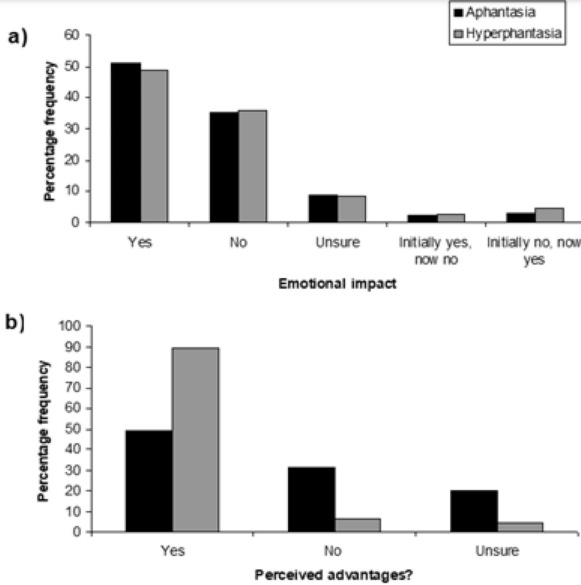
Emotional impact, perceived advantages, relationships
a sense of emotional impact was common for both groups, and didn’t differ between the two
aphantasics were singificantly less likely to see their condition as adventagous, and more likely to answer ‘unsure’
48.7% of aphantasics felt that their relationships are affected by their condition
95.5% of those affirmative answers felt the effect was negative
53% of hyperphantasics felt their relationships are affected by their condition
75.8% of those affirmative answers felt the effect was negative
EXTEND study [Imagery vividness score] distribution and sibling recurrence risk
There is approximately a 10x risk of aphantasia in siblings compared to the general population
Discussion:
People with hyperphantasia are more likely to be found in professions traditionally regarded as creative,
while those with aphantasia are more likely to work in computing, mathematics and science.
Aphantasia, in contrast to hyperphantasia, is reportedly associated with difficulty with face recognition, and many people with aphantasia describe impoverished memories of past personal events.
Conversely, people with hyperphantasia are more likely than those with aphantasia to report synaesthesia.
When asked to count mentally the number of windows in their home, people with hyperphantasiaeand mid-range imagery almost invariably consult a visual image while those with aphantasia describe a range of alternative strategies including the use of avisual spatial imagery, kinaesthetic imagery and amodal ‘knowledge’.
Most strikingly, people with aphantasia were more likely than those with average or vivid imagery to report an absence of dreams, or a-visual dreaming. Nonetheless, a majority (63.4%) of people with aphantasia report that they dream visually, in common with 98.5% of people with hyperphantasia and 89% of people with mid-range imagery vividness.
Most of those who do not dream visually report experiencing dreams in atypical narrative, textual, conceptual, auditory and emotional forms.
Secondly, while about half (54.2%) of our aphantasic participants describe an absence of imagery in any sense modality absence of the ‘mind's ear’, for example, as well as the mind's eye many experience imagery in one or more modalities other than vision, most often auditory.
Sampling from a large community biobank, the EXTEND study (http://exeter.crf.nihr.ac.uk/extend), indicates that the prevalence of aphantasia, defined as extreme performance on the most widely used measure of imagery vividness, is around .7%, that of hyperphantasia around 2.6%. [Nerdy note: this differs from other reports suggesting aphantasia is in around 2% of the population - the jury is still out, we’ll see as there are more studies done]
..In our large sample, the sex ratio is equal among those with aphantasia,
while there is a female preponderance among those with hyperphantasia.
Participants report a family history of aphantasia in first degree relatives more often than would be expected by chance, suggesting a possible genetic basis for imagery vividness, although environmental factors very likely play a part.
Zeman, Adam, Fraser Milton, Sergio Della Sala, Michaela Dewar, Timothy Frayling, James Gaddum, Andrew Hattersley et al. "Phantasia–the psychological significance of lifelong visual imagery vividness extremes." Cortex 130 (2020): 426-440.